
Subtitle: An open and community-led assessment of current wastewater management, risks and future infrastructure needs.
Abstract: This project plan sets out an open, community-led assessment of wastewater management across the Southern Moreton Bay Islands, where long-term reliance on onsite wastewater treatment systems, ageing infrastructure, small-lot constraints and future population growth have created a need for a clearer evidence base. By combining resident experience, Council data, background research, expert input, community surveys and potential citizen science monitoring, the project aims to document current system conditions, costs, risks and information gaps without assuming a preferred solution. The findings will support transparent community discussion and help determine whether a formal wastewater feasibility study is justified to guide future planning, funding and infrastructure decisions for SMBI.
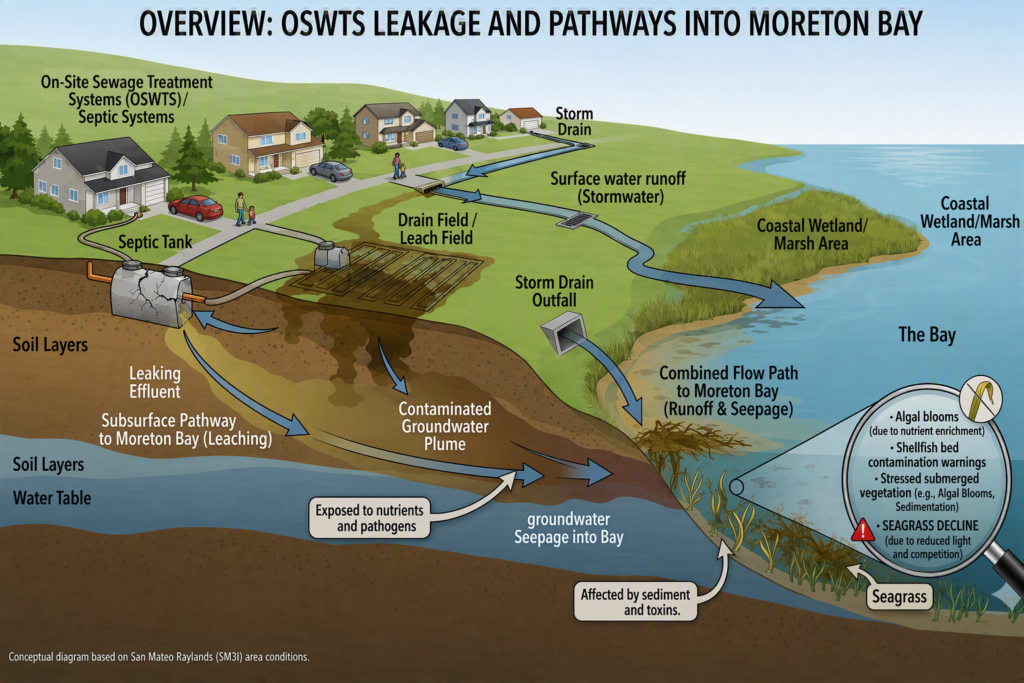
Why This Project Matters: The Southern Moreton Bay Islands — Russell, Macleay, Lamb and Karragarra — developed largely from early 1970s subdivisions that created thousands of small residential lots without reticulated sewerage. For more than five decades, wastewater has relied almost entirely on onsite wastewater treatment systems.
Wastewater management now includes legacy systems, traditional septic systems and modern treatment technologies. These systems have supported development, but there has been limited coordinated assessment of their performance as population grows, systems age and infrastructure expectations increase.
Why Now? Several factors make this the right time for an evidence-based assessment.
- The islands remain only partially developed, and future population growth is expected as approved residential lots continue to be built on.
- Many wastewater systems are ageing, while others were installed under earlier standards and regulatory frameworks.
- Community awareness of environmental protection, groundwater quality and Moreton Bay ecosystem values is increasing.
- There is no comprehensive evidence base to help residents, Council or other levels of government assess existing challenges or decide whether further investigation is needed.
This project does not assume sewerage is the answer, nor does it dismiss existing wastewater approaches. It seeks to understand the current situation and determine whether a formal wastewater feasibility study is justified.
Understanding the Current Situation: SMBI properties are not connected to a central sewerage network, so residential and commercial properties manage wastewater onsite. Current systems include legacy arrangements, traditional septic systems and modern treatment systems such as home sewage treatment plants and advanced passive technologies.
The diversity of systems across the islands means performance, maintenance requirements and replacement costs may vary significantly between properties.
Key Questions: The project seeks to answer the following questions.
- What types of wastewater systems currently operate on SMBI?
- What is the age profile of existing systems?
- What do we know about how well systems are functioning?
- What challenges are residents experiencing?
- What costs are currently being borne by households?
- What environmental and public health risks may exist?
- What constraints affect future development?
- Is there sufficient evidence to justify a wastewater feasibility study?
Project Purpose: The purpose of this project is to undertake an open, transparent and community-led assessment of wastewater management across SMBI and prepare an evidence-based report on whether a formal wastewater feasibility study should proceed.
The project is not intended to decide the future of wastewater management on SMBI. Its role is to provide the information needed for informed decision-making.
Project Objectives: The project will focus on the following objectives.
- Identify how wastewater is currently managed across SMBI.
- Understand resident experiences, including what works well and what problems are being reported.
- Document maintenance, repair, upgrade and replacement costs.
- Assess potential environmental and public health risks.
- Consider how future growth may affect wastewater management.
- Identify what the community wants to see happen next.
- Determine whether further investigation through a formal feasibility study is warranted.
Project Principles: The project will be guided by the following principles.
- Open and transparent: Activities, findings and recommendations will be shared where practical, with uncertainty clearly identified.
- Local knowledge matters: Resident experience will be treated as part of the evidence base.
- Evidence-led: Information from multiple sources will guide conclusions and recommendations.
- Privacy-respecting: Resident information will be handled respectfully and confidentially.
- Collaborative: The project will support learning, respectful discussion and shared understanding.
- Future-focused: The aim is to build a stronger foundation for future wastewater planning and investment.
How the Evidence Will Be Built: The project will combine local knowledge, research, community experience and environmental information so resident experience sits alongside technical evidence.
- Community Working Group: To guide the project, support communications, coordinate volunteers and review findings.
- Research and background review: To examine OSWTS performance, comparable communities, government guidance, health and environmental risks, small-lot constraints and emerging technologies.
- Data mapping: To review available Council data on historic OSWTS approvals, system types, approval dates and soil analysis.
- Expert consultation: To test current understanding with technical experts and relevant government policy decision makers.
- Community surveys and town halls: To capture resident experience, costs, concerns and feedback on emerging findings.
- Citizen science and environmental monitoring: To explore whether trained resident sampling and appropriate testing could help identify issues requiring further investigation.
Risks to Be Considered: The project will consider risks associated with current wastewater arrangements and future growth.
- Ageing wastewater systems and future replacement pressures.
- Small lot constraints affecting system selection, disposal options and compliance.
- Future population growth and increased wastewater generation.
- Wet-weather performance, drainage and inundation-prone areas.
- Affordability, household costs and potential financial pressure on residents.
- Community confidence, information gaps and future funding needs.
Bringing the Findings Together: The project will bring together research, community experience, environmental observations and technical information to identify common themes, local differences, information gaps and opportunities for improvement.
Key findings and the draft report will be made available for comment before finalisation, helping ensure the report accurately reflects community experiences and priorities.
Building the Case for the Next Step: SMBI’s wastewater challenge reflects historic subdivision decisions, long-term reliance on onsite systems, ageing infrastructure, ongoing growth and rising environmental expectations.
There is no comprehensive evidence base describing system condition, performance, costs, resident challenges, environmental risks or future growth implications. By combining community knowledge, research, environmental observations and technical expertise, this project will determine whether there is a strong case for a detailed wastewater feasibility study.
Want to be part of this project? If you live on, own property on, work on or care about the future of the Southern Moreton Bay Islands, you are invited to contribute your experience, questions and ideas. To get involved or register your interest, email Shane Rendalls at Shane.rendalls@redlands.qld.gov.au.