
The Southern Moreton Bay Islands (SMBI) face a unique density challenge: thousands of tightly packed small-lot subdivisions, rather than the larger acreage properties seen in many mainland communities. These approved small-lot subdivisions were created in the early 1970s, before the SMBI were transferred to Redland Shire in 1973.
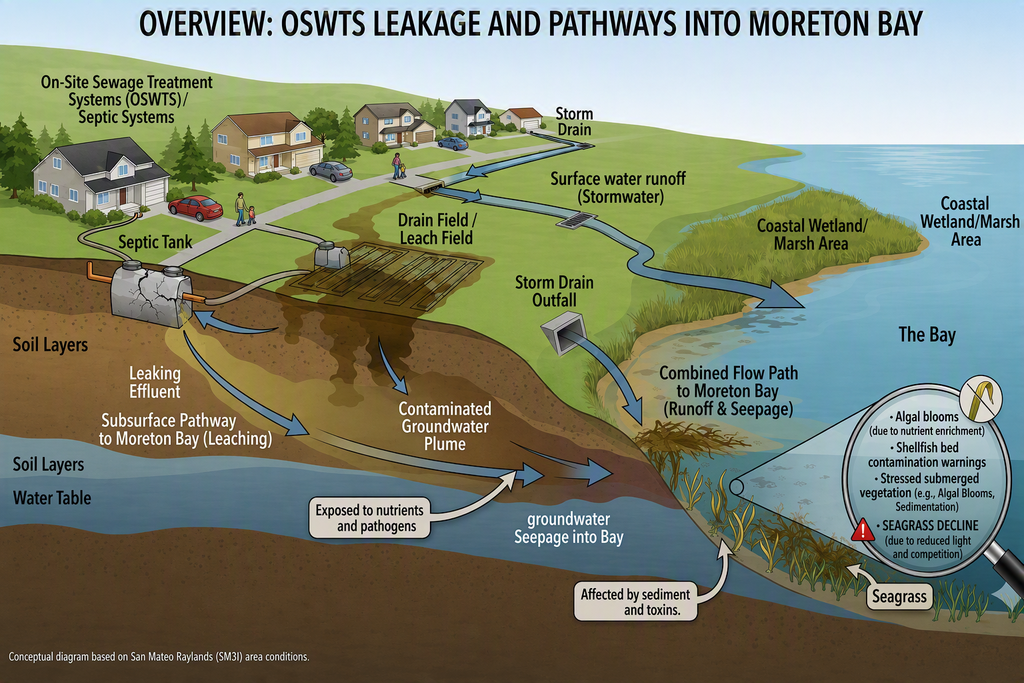
For 54 years, wastewater has largely been treated as a private backyard compliance issue rather than the regional public health, environmental, and infrastructure challenge it has become. The close proximity of backyard wastewater infrastructure increases the risk of effluent runoff, septic failure, and contamination reaching the sensitive marine environment of Moreton Bay.
The political record shows that wastewater has rarely received sustained public advocacy as a structural infrastructure issue. This work represents the first sustained effort to place SMBI wastewater clearly on the public agenda as an infrastructure challenge requiring a coordinated government response.
The pressure is already showing. Only about 43% of approved residential lots on the SMBI have been developed, yet wastewater problems are already occurring. Over the next 10 to 15 years, another 6,500 dwellings may be approved, pushing the island population towards 20,000 people. Council holds no legal mechanism to stop people building homes on the approved residential lots that they own.
Doing nothing is not a strategy. It leaves the community exposed to growing public health and environmental risks. As island populations increase, rainfall events intensify, and older wastewater systems reach the end of their working lives, the case for action becomes stronger.
Building an Evidence-Based Case for Action
This paper seeks to move the discussion beyond short-term compliance responses and towards a coordinated, evidence-based infrastructure solution.
The objective is to build a clear case for action, assess available options, identify the regulatory changes needed, and prepare a focused, costed proposal for a detailed SMBI wastewater feasibility study that can be taken to the State and Federal Governments for funding consideration.
This approach is also supported by professional networks developed through engagement with the Onsite Wastewater Treatment Association (OWTA) and broader local government forums. These networks connect the project with wastewater researchers, designers, providers, and regulators. This ensures the local strategy can be informed by proven engineering models and current industry practice, rather than dismissed as community frustration alone.
Current Wastewater Technology on the Islands
Russell, Macleay, Lamb, and Karragarra Islands are not connected to a central sewerage network. As a result, all properties rely on onsite wastewater systems. These systems have changed over time, and all three broad types are still represented across the islands:
- Legacy systems: Older split systems where toilet waste entered basic holding pits, while greywater often discharged directly onto surface soil.
- Traditional septic systems: Septic tanks that flow into absorption trenches and rely on soil to filter pathogens and nutrients.
- Modern treatment systems: Mechanical home sewage treatment plants that require power, regular servicing, and irrigation areas, alongside newer passive systems using gravity-fed treatment and dispersal.
The Lot-Size and Cross-Property Flow Problem
Under Queensland’s plumbing framework, a standard 3-to-4-bedroom home is generally assessed against a domestic wastewater load based on bedroom capacity, while commercial users face much higher daily volumes.
Australian Standard AS/NZS 1547 requires properties to set aside enough land to safely absorb treated wastewater. On many SMBI lots of around 500m² to 600m², this can be difficult. Once the house, water tanks, setbacks, driveways, and other structures are considered, there may be limited space left for safe wastewater dispersal. Council has historically managed this by limiting house size to the available wastewater capacity and requiring newer treatment systems where needed.
When systems fail or land becomes saturated after heavy rain, treated or partly treated effluent can pool on the surface and move downhill across property boundaries. This creates health risks for neighbours, causes local disputes, and places Council in the difficult position of responding to problems that are symptoms of a much larger infrastructure issue.
The Commercial Scaling Penalty (ERA 63)
For island businesses, wastewater rules can become a major barrier to growth. Once a business generates more than 4,200 litres of wastewater per day, it shifts from a local plumbing approval into a complex, costly State-level environmental framework.
- Environmental approval: Systems meeting or exceeding this 4,200-litre threshold are regulated as an Environmentally Relevant Activity (ERA 63) for sewage treatment, moving oversight from local plumbing approvals to State environmental regulation.
- Dispersal sites: Locating sufficient land for large-volume wastewater dispersal is exceptionally difficult, as getting regulatory approval to move effluent across property boundaries is highly restrictive.
- The cost barrier: Under an ERA 63 approval, local businesses face ongoing state licensing fees, specialist environmental engineering costs, nutrient-balance modelling, expanded land requirements for irrigation, and higher pump-out costs. The combination of small lot sizes and these overheads restrict commercial growth and limit the services available to island residents.
Environmental Risk to Moreton Bay
Wastewater carries nutrients such as nitrogen and phosphorus. On small island lots with sandy soils, these nutrients move through the ground easily, especially during heavy rain or when systems are overloaded. From there, they enter groundwater, stormwater drains, and eventually Moreton Bay.
Excess nutrients fuel destructive algal blooms, lower water quality, and threaten critical seagrass beds, fish habitats, and vulnerable marine life, including dugongs and sea turtles. This is why wastewater is not merely a private property issue; it is a whole-of-island and whole-of-bay crisis.
As a Ramsar wetland of international importance, Moreton Bay’s critical marine life and habitats must be protected from the escalating threats of wastewater discharge and pollution.
A Practical, Community-Led Approach
The cost of sewering the islands cannot be carried by Council and ratepayers alone. Other options must be evaluated, including targeted regulatory changes, support for commercial precincts, or smaller, decentralised, localised wastewater systems.
To move this issue forward without waiting for a massive external budget, the proposed framework uses community knowledge, local technical expertise, and structured evidence gathering across three key phases:
- Phase 1 — Background Review: Bring together the key facts so the community and governments can clearly see the scale of the problem.
- Review academic and professional research on onsite wastewater risks and the performance of different treatment systems.
- Survey residents about their experience with existing systems, their support for a sewerage solution, and their willingness to contribute to capital and maintenance costs.
- Map Council’s historical plumbing records, including soil types, absorption rates, and installed system types.
- Phase 2 — Community and Business Forums: Establish structured workshops for residents and business owners to explain what they are experiencing, what it is costing them, and what solutions they would support.
- Phase 3 — Citizen Science Water Testing: Mobilise and train local volunteers to collect physical evidence, including groundwater bore/well testing and surface runoff monitoring during heavy rainfall events.
The Case for External Funding: Historical Legacy and Collective Risk
This crisis is not a self-inflicted issue created by current island residents. It is a legacy failure dating back to before the islands were transferred to Redland Shire in 1973. The thousands of tightly packed, small-lot subdivisions resulted from poor regulation by the State Government of the era. When the transfer occurred, the State refused to absorb or enforce the infrastructure costs that the original developers should have paid.
For over half a century, this historic regulatory neglect has been treated as a private backyard compliance problem. Overcoming it requires a unified regional framework that creates economies of scale to address this structural deficit. By pooling resources under a coordinated strategy, all ratepayers are protected from the emergency costs required to remediate environmental or public health failures. Proactive management is far cheaper for the community than managing the fallout of a collapsed ecosystem.
However, the main hurdle is that higher levels of government turn a blind eye, treating SMBI wastewater as a non-priority. For example, of the $322 million+ allocated by the current Federal Government for regional wastewater infrastructure, not a cent went to the Southern Moreton Bay Islands. This omission ignores a community at the forefront of public health and environmental risk. Compounding this, mainland ratepayers do not see SMBI wastewater as a priority, nor do they want to subsidise it.
Shifting these dual perceptions is critical. Redland City must frame public and environmental health not as an isolated island issue, and not as a Redland issue, but as a broader state and national responsibility stemming from this shared historical grievance.
Developing a coordinated strategy to review the current situation, identify the issue, and articulate the risks is about building the case for state and federal funding. Armed with a data-backed regional risk framework, Council can transform a 50-year-old historical grievance into an active political lever. The marine environment of Moreton Bay does not recognise municipal, state, or federal boundaries. A contamination crisis on the islands threatens the region’s tourism, commercial fishing, lifestyle appeal, and economic health.
Framing a unified SMBI wastewater strategy as a collective regional asset allows Council to place accountability back on higher levels of government. Securing external funding is the only path to protect the financial and environmental health of all ratepayers—an objective that begins with a transparent, evidence-based assessment of our current baseline risks.
Acknowledgements
The author acknowledges and thanks Dr Sara Heger (Consultant and former University of Minnesota Researcher and Instructor) for her professional insights, technical guidance, and long-standing contributions to onsite wastewater management, which helped inform the development of this paper.
How You Can Help
If you want to contribute and be a part of this journey, please email shane.rendalls@redland.qld.gov.au to see how you can get involved with the project.